eSIM vs Physical SIM for Travel: Which Is Better in 2026?
eSIM vs Physical SIM for Travel: The Real Decision in 2026
If you’re comparing esim vs physical sim for travel, the real question is not which one sounds newer. If you haven’t checked the best eSIM for travel options, it’s much easier to overpay or pick the wrong plan. What matters is which one saves you time, avoids surprise charges, and works reliably once you land. For most travelers in 2026, eSIM is the better choice, but physical SIM still wins in a few important situations.
The best option depends on how you travel, how much data you use, and whether you need a backup line. If you pick the wrong one, you can end up stuck at the airport hunting for Wi-Fi, or paying more than you should for data you barely use.
What actually matters most for travelers
Forget the technical debate for a minute. The decision usually comes down to four practical things: setup speed, price, coverage, and flexibility.
- Setup speed: eSIM is usually faster because you can buy and activate it before departure.
- Price: physical SIM can be cheaper in some countries, but not always after airport markups.
- Coverage: both can be excellent if they use the same local network.
- Flexibility: eSIM makes it easier to keep your home SIM active for calls and bank codes.
That matters because travel connectivity is rarely about the cheapest sticker price. It’s about avoiding friction when you need maps, rides, translation apps, or a hotspot right away.
eSIM vs Physical SIM for Travel: Side-by-Side Comparison
Here’s the practical comparison most travelers need.
| Factor | eSIM | Physical SIM |
|---|---|---|
| Setup | Instant digital activation, often before you leave | Requires inserting a card, often purchased on arrival |
| Convenience | Very high, especially for multi-country trips | Lower, especially if you must find a store |
| Price | Usually competitive, sometimes slightly higher | Can be cheaper locally, but not always |
| Dual SIM use | Great for keeping your home number active | Only if your phone supports dual SIM slots or eSIM plus SIM |
| Hotspot support | Often supported, but plan-specific | Usually supported, also plan-specific |
| Best for | Short trips, multi-country travel, remote work, frequent flyers | Budget travelers, long stays, phones without eSIM support |
| Main limitation | Device compatibility and occasional setup friction | Physical swapping, store visits, and losing your home SIM |
Why eSIM is usually the better choice
For most travelers, eSIM is the smarter option. The biggest advantage is simple: you can buy a plan online, scan a QR code, and land with data already active. That is a huge advantage if you need a taxi, a map, or messaging the moment you arrive.
eSIM also makes dual-line travel easier. You can keep your primary number active for SMS verification, banking codes, and important calls while using travel data on the new line. For anyone working remotely or moving across multiple countries, that’s not a nice-to-have. It’s the main reason eSIM has become the default recommendation.
It also reduces the usual airport hassle. No kiosk hunt, no language barrier at a phone shop, and no risk of misplacing your home SIM in a tiny plastic tray. If you want the shortest path from landing to online, eSIM wins.
Best for short trips and multi-country itineraries
eSIM is especially strong for trips under two weeks and for itineraries that cross borders. If you are moving from France to Italy to Spain, a regional eSIM is much easier than buying a new physical card in every country.
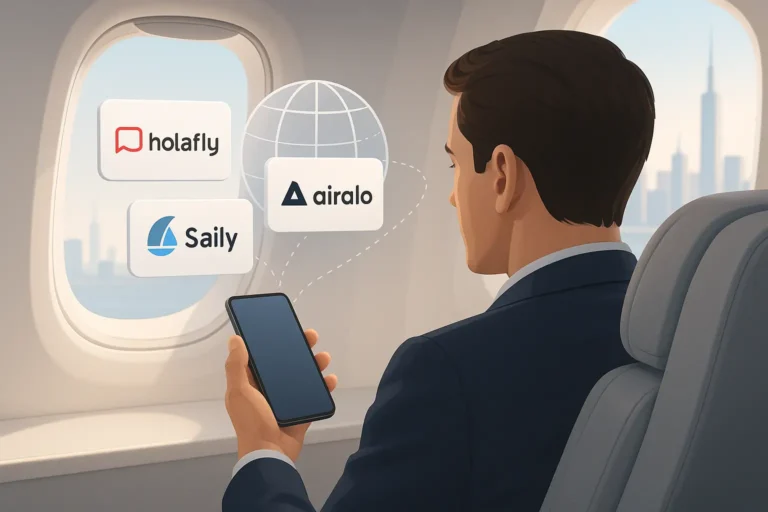
This is where comparisons like best esim for travel matter. The right provider can save you from juggling multiple SIM cards and separate top-ups.
Where physical SIM still makes sense
Physical SIM is not dead, and in some cases it is still the better buy. The most obvious reason is device support. If your phone does not support eSIM, the debate ends there.
Physical SIM can also be a sensible choice for long stays, especially in countries where local prepaid cards are cheap and easy to buy. If you’re staying a month or more and you want the absolute lowest cost, a local SIM from a major carrier may beat many travel eSIMs on price per gigabyte.
The catch is that this only works smoothly if buying and registering the SIM is easy. In some destinations, that process is painless. In others, it can waste an hour you would rather spend getting to your hotel.
Best for budget travelers and long stays
If you are staying in one country for a while and you don’t mind visiting a store, physical SIM can be the cheaper route. It’s also practical for heavy local data use when you find a prepaid plan with a lot of data at a low local rate.
That said, a cheap physical SIM is only cheap if it’s easy to buy and activate. If your first hour abroad becomes a setup chore, the savings start to look less impressive.
What to watch for before you buy
The best travel data option is not just about eSIM versus physical SIM. It’s about the details buried in the plan description.
- Check device compatibility: Not every phone supports eSIM, and some locked phones limit your options.
- Look at hotspot rules: Some plans allow tethering, others limit it or block it entirely.
- Read the fair-use policy: “Unlimited” often means a speed cap after a certain threshold.
- Confirm network partners: Good coverage depends on local carrier partnerships, not just the brand name.
- Check validity period: A 5GB plan lasting 7 days is very different from one lasting 30 days.
If you want a deeper breakdown, it helps to read what is an eSIM before you buy, so you understand how these plans actually work in practice. Most mistakes happen because travelers assume all plans behave the same. They don’t.
Best option by traveler type
Best overall: eSIM. It is the better choice for most travelers because it is faster, cleaner, and easier to manage alongside your main number.
Best for short trips: eSIM. You can activate it before departure and avoid wasting time after landing.
Best for multi-country travel: eSIM, especially regional plans. Switching borders is much simpler.
Best for budget long stays: Physical SIM, but only if the local market makes prepaid cards easy and cheap to buy.
Best for heavy data users: Whichever option offers the best local network and the most honest fair-use policy. Do not assume “unlimited” means truly unlimited.
Common mistakes travelers still make
The most common mistake is choosing based on device trendiness instead of actual trip needs. A shiny eSIM is useless if your phone does not support it or if the plan has weak coverage in the country you’re visiting.
Another mistake is buying too much data. Many travelers overestimate their needs because they think navigation, messaging, and basic browsing use more data than they do. Unless you’re streaming video or making frequent video calls, moderate data is usually enough.
The third mistake is forgetting that hotspot support can vary. If you plan to work from a laptop, or share data with a tablet, you need a plan that explicitly allows tethering.
So, which is better in 2026?
For most people, eSIM is better than physical SIM for travel in 2026. It is the safer pick because it cuts setup time, keeps your primary number active, and works especially well for short trips and multi-country travel.
Physical SIM is still worth using if your phone doesn’t support eSIM, or if you are staying in one country long enough to benefit from a cheap local prepaid card. But for the average traveler, it is the less convenient option.
If you want the simplest answer: choose eSIM unless you have a specific reason not to. That is the better default, and usually the better value once you factor in time, hassle, and flexibility.
FAQ
Is eSIM cheaper than physical SIM for travel?
Sometimes, but not always. eSIM often wins on convenience, while physical SIM can be cheaper in countries with very low-cost local prepaid plans.
Can I use eSIM and my regular SIM at the same time?
Yes, on most dual-SIM compatible phones. That is one of the biggest reasons travelers prefer eSIM.
Does eSIM work for hotspot and tethering?
Often yes, but it depends on the plan. Always check the provider’s hotspot policy before buying.
Is physical SIM better for long trips?
Sometimes. If you are staying in one country for weeks or months, a local physical SIM can offer better value.
What’s the biggest downside of eSIM for travel?
Device compatibility. If your phone does not support eSIM, or if it is carrier-locked, physical SIM may be the only option.