



Saily and Nomad are two popular travel eSIM providers for staying connected abroad without replacing your physical SIM card or paying traditional roaming rates. Both services offer prepaid mobile data in more than 200 destinations, including individual-country, regional, and global plans.
They solve the same basic problem, but the experience is different. Saily focuses on simple plan management, one reusable eSIM, and built-in security tools. Nomad puts more emphasis on destination-specific choice, with multiple data allowances, validity periods, and regional packages available across its catalog.
This comparison looks beyond advertised starting prices. We compare Saily and Nomad based on plan value, destination coverage, local networks, expected speeds, hotspot support, setup, app usability, security features, and customer support.
Provider information was checked on July 20, 2026. Prices, supported networks, and plan availability can change, so confirm the final details for your destination before purchasing.
In this comparison
Saily vs Nomad: Quick verdict
Saily is our better all-around choice for most travelers. Nomad remains a strong alternative when its available plan offers a better price, data allowance, or validity period for a specific trip.
Choose Saily if you want a clean beginner-friendly experience, one reusable eSIM for future trips, and additional features such as an ad blocker, web protection, and virtual location. It is especially compelling when its price is close to Nomad’s because those extras are included with the plan.
Choose Nomad if your priority is comparing multiple plan combinations for a particular destination. Its catalog makes it worth checking when you need a specific data allowance, longer validity, regional coverage, or simply the lowest available price for your route.
There is no universal price winner. The better option depends on your destination, trip length, expected data usage, and the plans available when you buy. Our recommendation is to compare equivalent packages rather than choosing based only on the lowest advertised starting price.
Disclosure: This article contains affiliate links. We may earn a commission if you purchase through them, at no additional cost to you. Our conclusions are based on provider features, pricing, and suitability for different types of travelers.
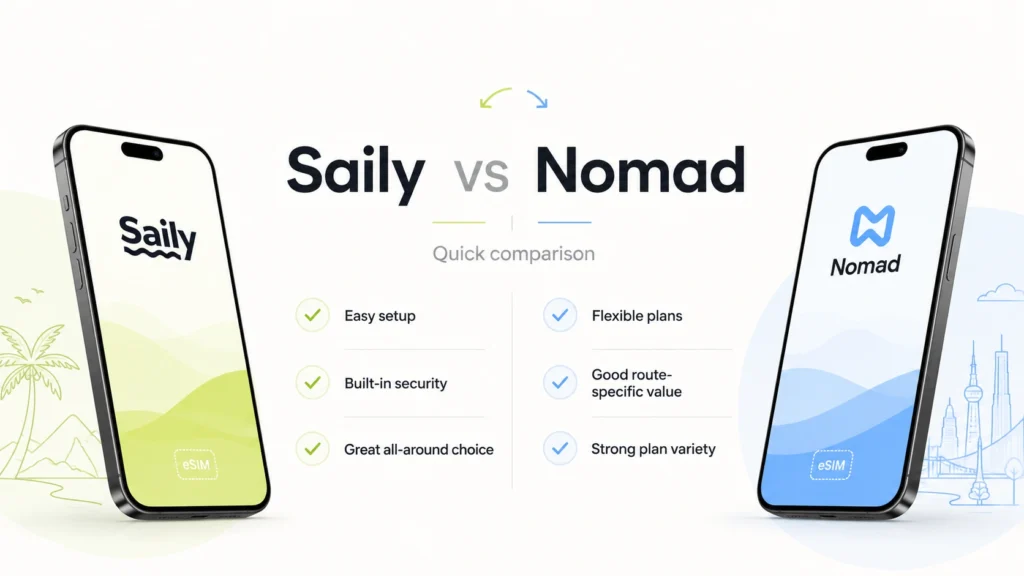
Saily vs Nomad at a glance
Saily and Nomad are closely matched on the essentials: both provide prepaid travel data, broad international coverage, automatic activation in most destinations, hotspot support, and 24/7 customer assistance. The main differences are in plan selection, repeat-trip convenience, and additional features.
| Category | Saily | Nomad | Our take |
|---|---|---|---|
| Best for | Travelers who want simplicity, security tools, and one reusable eSIM | Travelers who want more plan combinations for a specific destination | Depends on your priority |
| Coverage | 200+ destinations | 200+ destinations | Tie |
| Plan selection | Local, regional, global, fixed-data, and selected unlimited plans | Local, regional, global, fixed-data, and selected day or unlimited plans | Nomad |
| Repeat trips | New plans can be added to the existing Saily eSIM | Whether the existing eSIM can be reused or topped up depends on the plan | Saily |
| Installation | Direct installation through the app without manually entering an activation code | Direct app installation or QR-code installation | Saily by a small margin |
| Activation | Normally activates after connecting at the destination | Normally activates after connecting at the destination | Tie |
| Hotspot and tethering | Supported | Supported, subject to the selected plan and local network | Tie for most travelers |
| Security features | Ad blocker, web protection, and virtual location included with data plans | No comparable integrated security suite | Saily |
| Calls and SMS | Data-only by default, with an optional US phone-number add-on | Most plans are data-only; limited destination-specific exceptions exist | Saily |
| Customer support | 24/7 live chat and email | 24/7 live chat through the app or website | Tie |
| Overall advantage | Better integrated experience and useful extras | Greater emphasis on plan choice and destination-specific value | Saily for simplicity; Nomad for flexibility |
The practical difference is straightforward: Saily gives you the more complete product around the data plan, while Nomad gives you more reasons to compare individual packages before buying. If both providers offer similar data and validity at a similar price, Saily usually provides better overall value. If Nomad offers a substantially cheaper or better-matched package, its additional plan flexibility can matter more than Saily’s extra features.
For provider-specific details, see our full Saily eSIM review and Nomad eSIM review.
Saily vs Nomad plans and pricing
Nomad is cheaper for several popular destinations, while Saily wins on selected routes. There is no permanent price leader because both providers regularly adjust their plans, promotions, data allowances, and validity periods.
For a fair comparison, we checked equivalent 5 GB plans with 30-day validity in US dollars. The prices below were checked on July 20, 2026, before applying coupons or limited-time promotions.
| Destination and plan | Saily | Nomad | Lower standard price |
|---|---|---|---|
| United States — 5 GB for 30 days | US$13.99 | US$16.00 | Saily |
| Japan — 5 GB for 30 days | US$10.99 | US$10.00 | Nomad |
| United Kingdom — 5 GB for 30 days | US$12.99 | US$12.00 | Nomad |
| Europe regional plan — 5 GB for 30 days | US$19.49 | US$17.50 | Nomad |
This snapshot gives Nomad the lower standard price in Japan, the United Kingdom, and Europe, while Saily is cheaper for the United States. However, the differences are small enough that a promotion, coupon, or slightly different plan allowance can reverse the result.
Which provider offers better value?
Choose based on the complete plan rather than a difference of one or two dollars. A cheaper package is not necessarily better if it provides less data, expires too early, excludes part of your route, or does not match how you intend to use your phone.
- Light use: 1–3 GB may be enough for messaging, maps, ride-hailing, email, and occasional browsing.
- Typical holiday: 5 GB is a practical starting point for a one- or two-week trip with moderate navigation, browsing, and social media use.
- Heavy use: compare 10 GB, 20 GB, and unlimited plans instead of repeatedly purchasing smaller top-ups.
- Multi-country travel: a regional plan is normally more convenient than purchasing and installing a separate plan for every destination.
Saily provides stronger overall value when its price is close to Nomad’s and you intend to use its integrated security features and reusable eSIM experience. Nomad is the better purchase when its available package offers a meaningfully lower price, a more suitable validity period, or a data allowance that fits your trip more precisely.
Before purchasing, compare the final checkout price, included destinations, supported networks, validity period, and any fair-use limits attached to unlimited plans.

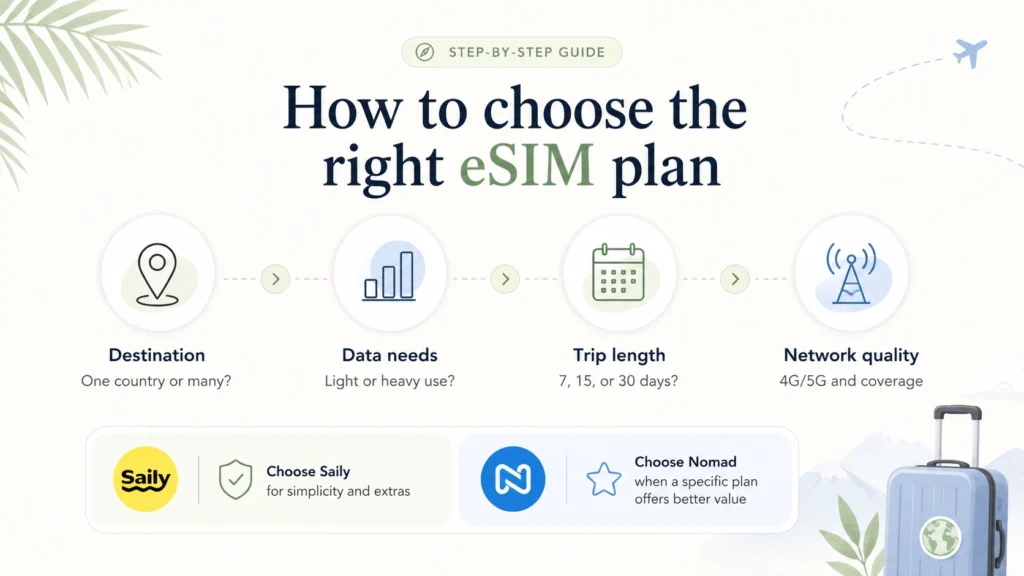
Coverage, networks, and speed
Coverage is effectively a tie: both Saily and Nomad offer data plans in more than 200 destinations. For most travelers, the more important difference is not whether a country is available, but which local network supports the selected plan and whether it includes 4G or 5G access.
Both providers connect through local carrier partners rather than operating their own mobile networks. As a result, connection quality can vary by destination, neighborhood, device, signal strength, and network congestion.
Local, regional, and global coverage
Saily and Nomad both sell country-specific plans as well as regional and global packages. A local plan usually makes the most sense for a single-country trip, while a regional plan is more convenient when traveling across several countries without wanting to install or manage a new package at every border.
- Local plan: usually the best starting point for one destination and often the easiest option to compare by price and network.
- Regional plan: better suited to itineraries across Europe, Asia, or another multi-country region.
- Global plan: convenient for long international trips, but normally more expensive per gigabyte and not guaranteed to include every destination.
Always check the complete country list before purchasing a regional or global plan. Two packages with similar names may include different destinations, territories, or partner networks.
4G, 5G, and expected performance
Saily lists speeds ranging from 3G to 5G depending on the destination and local network provider. Nomad generally advertises 4G or 5G connectivity on supported plans, but also notes that actual coverage and speed can vary by location and time of day.
Some Nomad plans list more than one supported local network. That can be useful when one carrier has weak coverage in a particular area, although the available networks depend on the exact destination and package. Saily may also connect through strong local carriers, but you should confirm the technical details shown for the individual plan rather than assuming every package has identical access.
Which provider is faster?
Neither provider is consistently faster worldwide. Saily may perform better on one route, while Nomad may have the stronger partner network in another country. Even users on the same plan can receive different results in a city center, airport, hotel, rural area, or crowded event.
When reliable connectivity matters, prioritize the listed partner network, 5G availability, included high-speed allowance, and destination coverage before comparing a small price difference.
Our verdict: overall coverage is a tie. Nomad gets a small transparency advantage when a plan clearly lists several available local networks, but neither provider can be declared the universal speed winner.
Hotspot and tethering
Both Saily and Nomad can share mobile data with a laptop, tablet, or another phone through a personal hotspot. For ordinary tethering, neither provider has a decisive advantage.
Saily provides official hotspot instructions for both iPhone and Android. Once the Saily eSIM is selected for mobile data, you can enable Personal Hotspot on iOS or Mobile Hotspot and Tethering on Android.
Nomad also supports tethering on most of its eSIM plans. However, Nomad notes that hotspot stability can occasionally depend on the device, destination, local network, and network congestion.
Which provider is better for hotspot use?
The provider matters less than the data allowance and local connection quality. A laptop can consume mobile data much faster than a phone, particularly during video calls, cloud synchronization, software updates, and streaming.
- Occasional email and browsing: a 5 GB plan may be sufficient for light tethering during a short trip.
- Regular remote work: compare plans with at least 10–20 GB, especially if you use video meetings or cloud-based tools.
- Heavy hotspot use: consider a larger fixed-data or unlimited plan, but check whether high-speed data is reduced after a daily usage limit.
If tethering does not work, confirm that the travel eSIM is selected for mobile data, restart the hotspot, check the plan’s APN settings, and temporarily disconnect any other SIM from mobile data.
Our verdict: hotspot support is a tie for most travelers. Choose Saily or Nomad based on the available local network and the amount of data included, rather than tethering support alone.
Setup and app experience
Saily is slightly easier for first-time eSIM users, while Nomad offers more flexibility through both its app and website. Neither setup is difficult, but Saily keeps more of the process inside one guided mobile experience.
Setting up Saily
After purchasing a plan, Saily guides you through installation directly in its mobile app. On compatible iPhone and Android devices, the automatic method transfers the eSIM profile into the phone settings without requiring you to manually copy an activation code.
A manual installation option is also available when automatic setup does not work. The app provides the required details and guides you through selecting the Saily eSIM for mobile data, enabling data roaming, and preparing the connection before departure.
Setting up Nomad
Nomad primarily uses a QR code for installation. The code and instructions are available after purchase through the confirmation email, Nomad app, or the Manage section of the website. You then add the eSIM through your phone’s cellular or SIM settings.
This adds one extra step compared with Saily’s guided app installation, but it also gives Nomad users more ways to retrieve and manage their plan. If the original email is lost, the QR code and installation details remain accessible from the account.
What to do before your trip
- Install while connected to reliable Wi-Fi: do not wait until you are standing at the airport without a stable internet connection.
- Keep your primary SIM enabled carefully: use it for calls if needed, but select the travel eSIM as the mobile data line to avoid roaming charges.
- Enable data roaming for the travel eSIM: this is normally required for it to connect through a partner network.
- Do not delete the eSIM during troubleshooting: check the APN, restart the phone, or contact support first.
In most cases, both providers activate after the eSIM connects to a supported local network at the destination. Nomad may also require manual activation for selected plans, so the instructions supplied with the purchase should always take priority.
Android users can follow our complete guide on how to install an eSIM on Android.
Our verdict: Saily wins narrowly for beginners because its app handles more of the installation process directly. Nomad remains straightforward and is better suited to travelers who appreciate managing their eSIM through either a mobile app or a browser.
Security and extra features
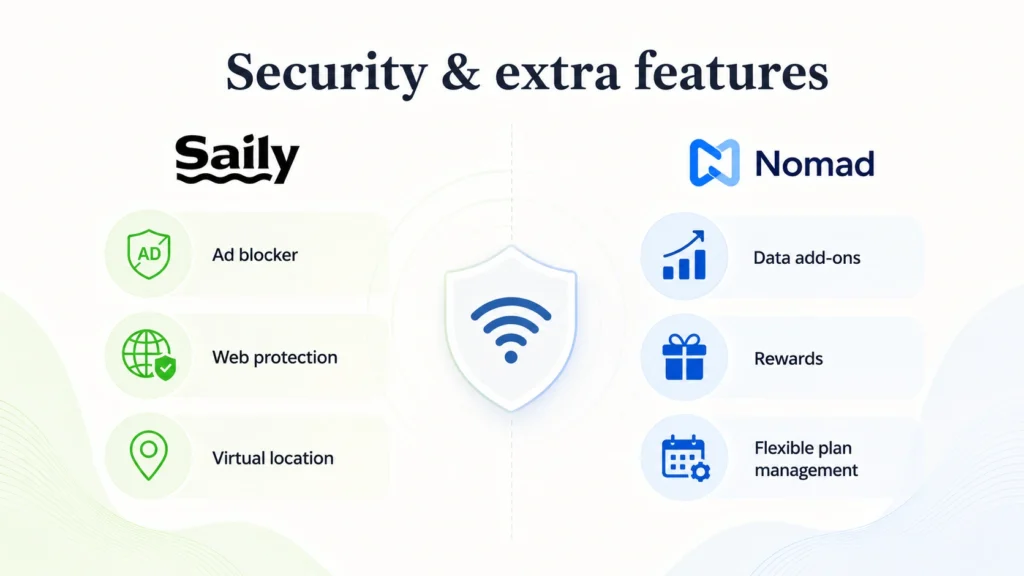
Saily has the clear advantage in additional security features. Nomad provides a secure standard travel eSIM service, but Saily adds several privacy and browsing tools directly inside its app.
What Saily adds to the data plan
- Ad blocker: filters many advertising domains and can reduce unnecessary data usage while browsing.
- Web protection: blocks known malicious websites and limits some online trackers.
- Virtual location: routes your connection through a selected remote location, making it harder for websites to determine your actual browsing location.
These tools add useful protection, but they are not replacements for good security habits. DNS-based filtering cannot remove every advertisement or detect every malicious file, and virtual location should not be treated as complete anonymity.
Nomad rewards and data add-ons
Nomad focuses more on extending and managing the data plan. Compatible plans can be topped up with an add-on before the existing allowance runs out, allowing you to continue using the same eSIM profile instead of installing another one.
Nomad also offers loyalty points on eligible purchases. The points can be redeemed for discounts or other benefits, although earning and redemption rules may change and should not outweigh the actual price and suitability of the plan.
Which provider offers better extras?
Saily wins this category comfortably. Its ad blocker, web protection, and virtual location provide practical value beyond basic mobile data. Nomad’s top-ups and rewards are useful, but they improve account management rather than browsing security.
If both providers offer similar coverage, data, and pricing for your destination, Saily’s additional features give it the stronger overall package. Nomad remains attractive when its plan is cheaper or fits your trip more precisely.
Customer support
Both Saily and Nomad provide 24/7 customer support, so neither has a major advantage in availability. The main difference is how you access help and how much useful information you provide when opening the request.
Getting help from Saily
Saily offers live chat and email support around the clock. Live chat is accessed through the Saily mobile app, where an automated assistant may first collect information before transferring the conversation to a support agent when necessary.
The app-based process is convenient when your plan, device details, and installation information are already connected to the same account. Saily does not provide telephone support.
Getting help from Nomad
Nomad provides live chat through both its mobile app and website. This is useful when your phone has connection problems and you prefer to contact support from a laptop or another device.
Installation instructions, plan details, and common troubleshooting steps are also available through Nomad’s online Help Center.
How to get a faster resolution
- Include your order number, destination, phone model, and operating system.
- Explain whether the problem involves installation, activation, mobile data, hotspot use, or billing.
- Attach screenshots of the eSIM settings, network status, and any error message.
- Do not delete the eSIM profile unless the support team specifically tells you to remove it.
Our verdict: support availability is a tie. Saily offers a streamlined app-based experience, while Nomad has a small accessibility advantage because live chat is available through both the app and website.
Final verdict: Saily or Nomad?
Saily is the better all-around choice for most travelers, but Nomad can provide better value for a specific destination. The right decision ultimately depends on the available plan, local network, data allowance, validity period, and total price for your trip.
Choose Saily if you want:
- A simple and beginner-friendly installation process.
- One reusable eSIM for multiple future trips.
- Built-in ad blocking, web protection, and virtual location features.
- A polished app that keeps purchasing, installation, and plan management in one place.
- A strong default option without spending too much time comparing similar plans.
Choose Nomad if you want:
- More plan combinations for a particular destination or region.
- More control over data allowance, validity, and available local networks.
- The ability to research and manage plans through both an app and website.
- A cheaper package or better price per gigabyte for your specific route.
- Data add-ons for a compatible active plan.
Our overall winner
Saily wins this comparison for most international travelers. It combines competitive pricing and broad coverage with easier installation and useful security features that Nomad does not currently match.
However, the difference is not large enough to ignore the actual plans available for your destination. When Nomad offers more data, longer validity, a stronger listed network, or a meaningfully lower price, it can easily become the better purchase.
Simple decision: choose Saily when the plans are broadly similar. Choose Nomad when its specific package offers clearly better value for your trip.
For a closer look at each service, read our complete Saily eSIM review and Nomad eSIM review. You can also compare them with other leading providers in our guide to the best eSIMs for international travel.
Saily and Nomad pros and cons
Saily and Nomad are both reliable travel eSIM providers, but they prioritize different things. Saily offers the more polished all-around experience, while Nomad gives travelers more flexibility when selecting a destination-specific plan.
| Category | Saily | Nomad |
|---|---|---|
| Pros |
|
|
| Cons |
|
|
| Best for | Travelers who value simplicity, security tools, and a streamlined experience. | Travelers who want to optimize data, validity, coverage, and price for a specific trip. |
Bottom line: Saily is easier to recommend when both providers offer similar plans at similar prices. Nomad becomes the stronger choice when its available package is noticeably cheaper or better matched to your route, trip length, and expected data usage.
Frequently asked questions
Is Saily better than Nomad?
Saily is the better all-around option for most travelers because of its guided installation, polished app, and additional security tools. Nomad may be better when it offers a cheaper plan, more suitable validity period, or stronger network options for a specific destination.
Which is cheaper, Saily or Nomad?
Neither provider is consistently cheaper in every country. Prices vary by destination, data allowance, validity period, and available promotion. Compare the exact plans for your trip rather than assuming one provider always offers better value.
Do Saily and Nomad support personal hotspot?
Yes, both providers generally allow tethering through a personal hotspot. Hotspot performance still depends on the selected plan, phone, local network, signal strength, and available data allowance.
Do Saily and Nomad eSIMs include calls and text messages?
Most Saily and Nomad travel plans are designed primarily for mobile data and do not include a traditional local phone number. Keep your primary SIM active for calls and SMS when necessary, but disable its mobile data roaming to avoid unexpected charges. Always check the individual plan details before purchasing.
Can I install the eSIM before traveling?
Yes. Installing the eSIM while connected to reliable Wi-Fi before departure is usually the safest approach. The plan will normally begin when it connects to a supported network at the destination, although activation rules can vary between individual packages.
Can I reuse a Saily or Nomad eSIM?
Saily is designed around keeping one eSIM profile installed and purchasing additional plans for future trips. Nomad may allow an existing eSIM to be topped up or reused when the selected plan supports add-ons, but this is not guaranteed for every package.
Which provider is better for beginners?
Saily is slightly easier for first-time users because installation and plan management are handled through a guided app experience. Nomad is still straightforward, but its QR-code installation and larger selection of similar plans may require more comparison.
Which provider is better for frequent travelers?
Saily is convenient for travelers who want one reusable eSIM and a consistent app experience across multiple trips. Nomad may be preferable for travelers who regularly compare providers and want more control over destination-specific data amounts, validity periods, and pricing.