









The best eSIM for Japan is not simply the plan with the lowest headline price. The right choice depends on how long you are staying, how much full-speed data you need, which Japanese networks the plan can use, whether hotspot sharing is allowed, and what happens if setup fails.
We compared six providers for trips lasting 7–21 days and using 5–20GB of data. Prices, plan details and terms were checked on September 16, 2026. If Japan is one stop on a wider itinerary, browse our eSIM guides by destination before deciding between a country plan and a regional plan.
Disclosure: This article contains sponsored placements and affiliate links. Our rankings remain independent. We may earn a commission at no extra cost to you.
Best eSIM for Japan: Quick Verdict
Saily is our top pick at regular public prices, scoring 82.2/100. It combines competitive 5GB, 10GB and 20GB plans with clearly documented KDDI and SoftBank access, straightforward arrival activation, useful app controls and strong customer terms. Its lead is small, so it is the best all-round starting point rather than an automatic choice for every traveler.
Airalo is the runner-up at 78.5–80.5/100 and is especially useful when a 7- or 15-day plan matches the trip more closely.
Nomad eSIM ranks third at 77.3/100 at regular prices and is a strong choice for higher data use or onward travel in Asia. Its 50GB/30-day Japan plan was US$35 at our price check, with hotspot support and eligible fixed-plan add-ons. For a multi-country itinerary, compare its separate APAC plans and check that every stop is included. Sales and eligible first-purchase offers can add further value.
Ubigi stands out for an eight-day unlimited option, Jetpac for travel extras and sale pricing, while Holafly is a custom-duration unlimited alternative that is not numerically ranked because its Japan page does not publish a fixed high-speed allowance or guaranteed reduced speed.
Table of Contents
Best Japan eSIMs at a Glance
| Provider | Score /100 | Best for | Main strength | Main limitation |
|---|---|---|---|---|
| 1. Saily | 82.2 | Most travelers using 5–20GB | Strong regular-price balance, KDDI and SoftBank access, and useful app controls | Fixed-data plans top out at 20GB |
| 2. Airalo | 78.5–80.5 | Short 7- or 15-day trips | Wide choice of short-validity fixed-data plans | Plan-specific 5G access is not stated for the compared plans |
| 3. Nomad eSIM Sponsored partner |
77.3 | High-data value and onward Asia travel | 50GB/30-day Japan plan, hotspot, eligible add-ons and separate APAC options | Networks vary by plan; check that the selected APAC package covers every stop |
| 4. Ubigi | 76.0 | Heavy use on an eight-day trip | Eight-day unlimited option with 5GB per day at full speed, then 2 Mbps | The closest high-data fixed plan is 25GB for $32 |
| 5. Jetpac | 74.1 | Travel extras and sale pricing | KDDI and Rakuten 4G/5G access, hotspot use and travel benefits | High-data plans are expensive at regular prices |
| Holafly | Not scored | Flexible-duration unlimited data | Custom validity from 1 to 90 days | No fixed high-speed allowance or guaranteed reduced speed is published |
Scores use regular public prices for trips lasting 7–21 days and using 5–20GB. Promotions are treated separately because they can change. Airalo has a score range because the selected Japan plan pages name KDDI and SoftBank but do not state whether those plans include 5G. Holafly is not scored because its Japan page does not publish a fixed high-speed allowance or guaranteed reduced speed. See how we ranked the providers.
How We Compared the Providers
We scored plans for three practical Japan trips: 5GB over 7 days contributed 25% of the result, 10GB over 14 days contributed 50%, and 20GB over 21 days contributed 25%. For each provider, we selected the smallest regular fixed-data plan that supplied enough data and remained valid for the entire trip.
The 100-point score covers price and value (30), data limits and hotspot use (25), network options (15), setup and plan management (20), and terms and support (10). Prices and policies were checked on September 16, 2026. Across the five scored providers, the regular-price reference medians were $10, $17.99 and $26 for the three data needs. Temporary sales and discount codes were assessed separately.
We used provider product pages, help centers, terms and setup documentation. We did not run independent speed tests in Japan, so the network score reflects documented operators and stated 4G/5G access—not guaranteed speed, coverage or priority at every location.
| Provider | Price /30 | Data /25 | Networks /15 | Setup /20 | Terms /10 | Total /100 |
|---|---|---|---|---|---|---|
| Saily | 22.2 | 15.0 | 15.0 | 20.0 | 10.0 | 82.2 |
| Airalo | 23.0 | 15.0 | 13.0–15.0 | 17.5 | 10.0 | 78.5–80.5 |
| Nomad eSIM | 22.5 | 15.0 | 12.3 | 17.5 | 10.0 | 77.3 |
| Ubigi | 22.5 | 15.0 | 15.0 | 15.0 | 8.5 | 76.0 |
| Jetpac | 18.1 | 15.0 | 15.0 | 17.5 | 8.5 | 74.1 |
| Holafly | — | — | — | — | — | Not scored |
Airalo’s range comes from one unresolved detail: its compared Japan plan pages name KDDI and SoftBank but do not state whether those specific plans include 5G. Holafly is not scored because its Japan page does not publish a fixed daily high-speed allowance or guaranteed post-limit speed, preventing a like-for-like unlimited-data comparison.
How Stable Is the Ranking?
Saily stayed first when we increased or reduced the importance of each scoring category by 20%. Its smallest lead over Airalo’s best-case total was about 1.2 points, so Saily is the most balanced choice rather than a runaway winner. Airalo can still be the better fit when its 7- or 15-day validity closely matches the trip.
Current deals narrow the gap. Using only the best eligible price for each trip and never stacking offers, Nomad eSIM reaches an indicative 80.7 and Jetpac 79.8. These are temporary shopping snapshots, not replacements for the regular-price scores above.
Japan eSIM Plans, Prices and Fair-Use Limits
Fixed-data plans are the best-value default for most 7–21-day trips. They provide a clear allowance and avoid the daily full-speed limits attached to many unlimited products. The table below uses the smallest available plan that covers each trip’s data and validity requirements, so some packages last longer or include more data than the trip itself requires.
Fixed-Data Plans and Prices
| Provider and plan | Price (USD) | Data | Validity |
|---|---|---|---|
| For a 7-day trip using 5GB | |||
| Saily — 5GB plan | $10.99 | 5GB | 30 days |
| Airalo — 5GB plan | $10 | 5GB | 7 days |
| Nomad eSIM — 5GB plan | $10 | 5GB | 30 days |
| Ubigi — 5GB plan | $10 | 5GB | 15 days |
| Jetpac — 5GB plan | $10 | 5GB | 30 days |
| For a 14-day trip using 10GB | |||
| Saily — 10GB plan | $17.99 | 10GB | 30 days |
| Airalo — 10GB plan | $17.50 | 10GB | 15 days |
| Nomad eSIM — 10GB plan | $18 regular $16 sale |
10GB | 30 days |
| Ubigi — 10GB plan | $16.50 | 10GB | 30 days |
| Jetpac — 10GB plan | $23 regular $16 sale |
10GB | 30 days |
| For a 21-day trip using 20GB | |||
| Saily — 20GB plan | $24.99 | 20GB | 30 days |
| Airalo — 20GB plan | $25 | 20GB | 30 days |
| Nomad eSIM — 20GB plan | $26 regular $23 sale |
20GB | 30 days |
| Ubigi — 25GB plan | $32 | 25GB | 30 days |
| Jetpac — 20GB plan | $40 | 20GB | 30 days |
Jetpac’s current sale creates an unusual price ladder: its 30GB/30-day plan was $29.99, which is cheaper than the regular $40 price of its 20GB plan. That can make Jetpac more competitive at checkout, but the regular-price score remains based on the comparable 20GB package.
Unlimited Plans and Fair-Use Limits
Unlimited does not mean unlimited full-speed data. Most plans reduce speeds after a daily allowance, and hotspot rules vary. Our guide to unlimited travel eSIMs explains how to compare these limits before choosing a plan for streaming, remote work or frequent hotspot use.
| Provider and plan | Price (USD) | High-speed data | After the allowance | Hotspot |
|---|---|---|---|---|
| Saily — 15 days | $48.99 | 5GB per day | Up to 1 Mbps until the daily reset | Allowed |
| Airalo — 15 days | $48 | 3GB per 24 hours | 1 Mbps until the 24-hour reset | Allowed; no separate limit |
| Nomad eSIM — 14 days | $41 | 2GB per day | 1 Mbps after the daily high-speed allowance | Allowed |
| Ubigi — 8 days | $25 | 5GB per day | 2 Mbps until the daily reset | Data sharing supported |
| Jetpac — 30 days | $150 regular $65.99 sale |
3GB per 24 hours | Up to 1 Mbps until the reset | Allowed; no separate published limit |
| Holafly — 15 days | $50.50 | No fixed amount published | May be reduced until the following day; no rate stated | 1GB per day |
Ubigi publishes the most generous fair-use terms in this group: 5GB per day at full speed and 2 Mbps afterward. Nomad eSIM costs less than the roughly two-week alternatives shown, but its high-speed allowance is 2GB per day. Holafly offers the most flexible duration, yet its missing fixed allowance and reduced-speed figure make it harder to assess for remote work or heavy tethering.
For most travelers using less than 20GB over two weeks, fixed data is usually cheaper and more predictable. Unlimited is worth paying for when daily use is difficult to estimate or you prefer the connection to continue at reduced speed instead of stopping when a fixed allowance runs out.
Japan eSIM Provider Reviews
The overall score identifies the best all-round option, but it does not make one provider ideal for every traveler. The reviews below focus on the differences that matter after price: Japanese network access, activation, hotspot use, app controls, customer terms and the main reason to choose—or avoid—each service.
1. Saily: Best Overall at Regular Prices
Saily is the best all-round Japan eSIM for most trips lasting 7–21 days. Its 82.2/100 score combines competitive regular prices with documented access to KDDI and SoftBank, 4G/LTE/5G where available, unrestricted hotspot use, straightforward arrival activation and clear customer terms.
Fixed-data choices run from 1GB for 7 days to 20GB for 30 days. You can install the eSIM before departure, turn it on with data roaming enabled, and let the plan activate when it first connects in Japan. The app displays remaining data and expiry, supports top-ups, and lets you reuse the same Saily eSIM for later supported destinations instead of installing a new profile for every trip.
Saily also includes a virtual-location feature, an ad blocker that can reduce some trackers, and web protection for known malicious sites. These are useful extras on a travel connection, although they are not a replacement for a full VPN with device-wide traffic tunneling.
The main limitation is the gap above 20GB in the fixed-data range. Heavy users must move to the 15-day unlimited plan—with 5GB per day at full speed and up to 1 Mbps afterward—or choose a larger fixed package elsewhere. Saily’s terms provide a full-refund route for an unactivated plan and a separate remedy for eligible service failures; 24/7 chat support is also available. An unused plan activates automatically after 180 days, so there is little reason to buy it more than six months before departure.
Read our Saily eSIM review for a closer look at its app, security tools, refund rules and limitations.
Saily Discount Code
MyTechGuide Reader Offer
Save 10% on an Eligible Saily Purchase
Use code MYTECHGUIDE for 10% off an eligible Saily purchase.
MYTECHGUIDE
10% OFF
Open Saily through the button below and enter MYTECHGUIDE at checkout.
Terms: Apply the code to an eligible Saily purchase and confirm that the discount appears before payment. Availability and eligibility can change. This offer was not used in the regular-price ranking above.
2. Airalo: Best for Shorter Trips
Airalo is the runner-up at regular prices and the better fit when a 7- or 15-day package closely matches the trip. Its 78.5–80.5/100 score combines competitive fixed-data pricing, access to SoftBank and KDDI, flexible validity periods and strong customer support.
The most useful matches are 5GB for 7 days at $10, 10GB for 15 days at $17.50 and 20GB for 30 days at $25. Airalo also offers shorter three-day packages and unlimited plans, so it is easier to avoid paying for a long validity period on a brief stop in Japan.
The score range comes from one unanswered network detail, not a changing price. Airalo names SoftBank and KDDI for Japan, but the selected fixed-data plan pages do not explicitly state whether those packages include 5G. That does not prove 5G is unavailable; it simply means the network score has to remain a range. Airalo’s coverage information also includes Hokkaido and Okinawa, although real signal quality still depends on the local network and location.
You can install the eSIM before departure, and the package starts when it first connects to a supported network in Japan. The purchase can remain unused for up to 365 days before activation. Where available, top-ups and automatic renewals can be managed from the account instead of installing a new eSIM. Airalo provides 24/7 support, a 14-day withdrawal route before activation, and refund or replacement options for eligible service problems covered by its terms.
Read our Airalo eSIM review for more detail on installation, top-ups, coverage and refund conditions.
3. Nomad eSIM: Best for High-Data Value and Asia Trips
Nomad eSIM ranks third at regular prices with 77.3/100, but it becomes especially attractive if you need more than 20GB or will continue to another Asian country. Its 50GB fixed plan costs $35 for 30 days, while current sales can narrow the gap with the higher-ranked options. Because those offers can change, our base ranking still uses regular public prices.
Fixed-data choices currently start at 1GB for 7 days at $4 and extend to 50GB for 30 days at $35. The most useful mid-range options are 5GB for 30 days at $10, 10GB for 30 days at $18 regular or $16 on sale, and 20GB for 30 days at $26 regular or $23 on sale. Hotspot sharing is allowed on the checked plans. Eligible fixed plans also support add-ons in the app, so you can buy more data without installing another eSIM.
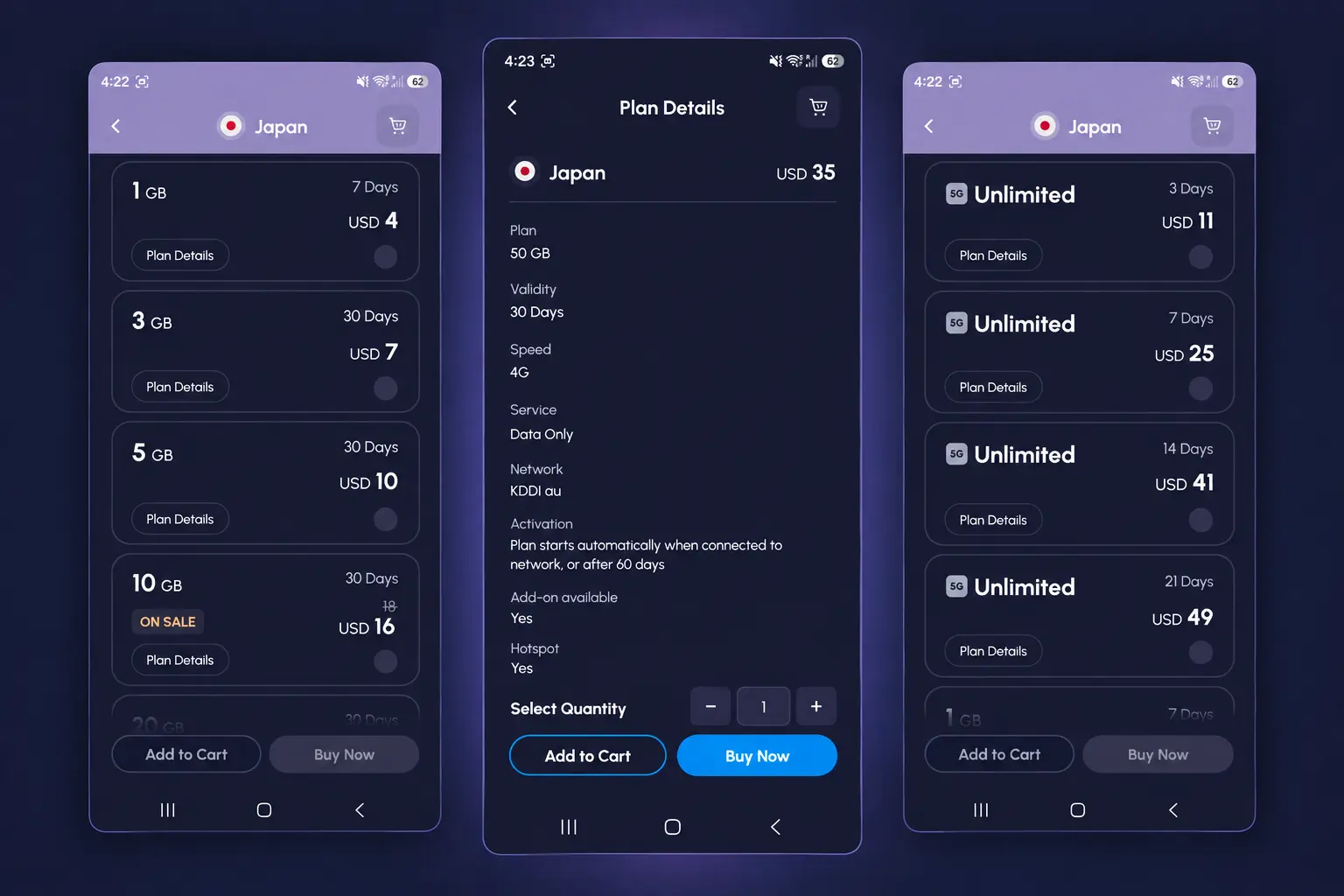
Network access depends on the exact package. The checked 5GB and 10GB fixed plans list 4G on KDDI au and SoftBank, while the checked 20GB plan lists 4G on KDDI au only. This is why Nomad eSIM does not receive full network points in our score. Check the current plan details instead of assuming that every Japan package includes both networks or 5G.
Unlimited options are available for 3, 7, 14 and 21 days. The 14-day plan costs $41 and includes 2GB of high-speed data per day; after the daily allowance, speeds drop to 1 Mbps until the next reset. The checked plan lists 4G/5G on KDDI au and SoftBank and permits hotspot use. Unlimited plans do not support add-ons and are non-refundable, so fixed data may be the safer choice when your usage is predictable or your itinerary could change.
You can install the eSIM by QR code or through the app before departure. The checked plans start when they first connect to a supported network in Japan or automatically after 60 days if still unused. The app displays remaining data and validity, while live chat and email support are available around the clock. These are data-only plans, so they do not include a Japanese phone number or standard calls and texts, although internet-based calling apps still work. Eligible fixed plans have refund routes before activation or when a covered service failure is verified.
Japan-Only or Multi-Country Asia Coverage?
A Japan plan is the simpler choice if you will remain in one country. If the same trip also includes destinations such as South Korea, China, Singapore or Thailand, compare a Nomad APAC plan before buying separate eSIMs. The included countries, data allowance, validity and price vary by regional package, so confirm that the exact plan covers every stop on your itinerary.
Nomad eSIM Free Trial
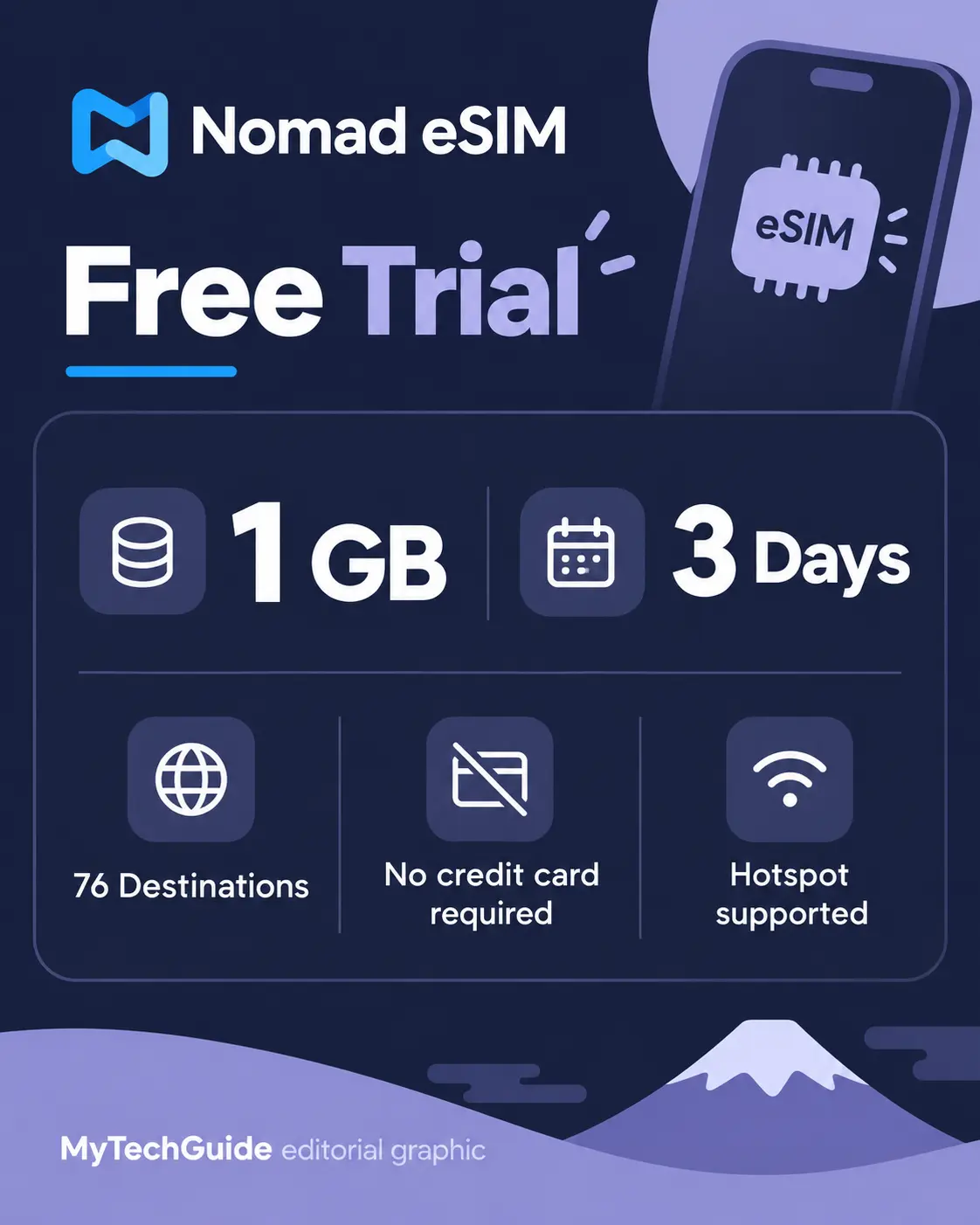
Eligible new users can claim a Nomad eSIM Free Trial with 1GB for 3 days, no payment card required and hotspot use included; Japan is one of the supported destinations. Redeem it close to departure because the trial may activate automatically 15 days after redemption even if you have not traveled. The Free Trial and the first-purchase discount are alternatives: redeeming the Trial removes eligibility for first-time-user offers, so do not plan to stack them.
For a broader look at installation, account management, support and plan limitations, read our Nomad eSIM review.
Nomad eSIM Discount Code
MyTechGuide Reader Offer
Save 15% on an Eligible First Nomad eSIM Purchase
Use code MYTECHGUIDE15 for 15% off one eligible first purchase.
MYTECHGUIDE15
15% OFF
Open an eligible Japan plan through the button below and enter MYTECHGUIDE15 at checkout.
Terms: Single use on one eligible first purchase. The affiliate link must be used. Excludes plans under $5, sale plans, add-ons, unlimited plans and the Thailand 50GB plan. The Free Trial and code are alternatives; redeeming the Trial removes eligibility for first-time-user offers. Offers and eligibility can change.
4. Ubigi: Best for an Eight-Day Unlimited Plan
Ubigi scores 76.0/100 and is the strongest choice in this comparison for heavy data use on an eight-day trip. Its $25 unlimited plan offers a more generous daily high-speed allowance and a faster reduced-speed tier than the other unlimited options we checked. For ordinary fixed-data use, however, Ubigi finishes behind the top three because its closest high-data package is larger and more expensive than the 20GB plans most travelers would compare.
The fixed-data range includes 5GB for 15 days at $10, 10GB for 30 days at $16.50 and 25GB for 30 days at $32. The 5GB and 10GB options are competitively priced for short or moderate-use trips. The jump to 25GB is less efficient if you only expect to use about 20GB, although it may still suit travelers who want extra headroom without choosing unlimited data.
The eight-day unlimited plan includes 5GB of full-speed data every 24 hours. After that allowance is used, speeds are reduced to 2 Mbps until the next reset. Data sharing is allowed, making the plan practical for tethering a laptop or a second device. The current Japan plan pages list KDDI and NTT Docomo with 4G and 5G access where available, but actual signal and speed still depend on the local network and location.
Ubigi sends the eSIM by QR code and lets you install it before departure. SmartStart begins the plan’s validity when it connects at the destination; an unused plan expires automatically if it is not activated within six months of purchase. The same Ubigi eSIM profile can be reused for plans in other supported destinations, while the app shows the remaining balance and supports top-ups after the original allowance runs out.
Ubigi is a data-only service, so it does not provide a Japanese phone number or standard calls and texts. An unused preloaded plan may qualify for a refund, but a request can be denied once any data has been used. Refund requests require proof of payment and must be submitted within 14 business days of purchase or an eligible technical problem. Ubigi provides an online support form, although it does not publish round-the-clock support hours.
Read our Ubigi eSIM review for more detail on its reusable profile, installation, hotspot use and plan management.
5. Jetpac: Best for Travel Extras and Sale Pricing
Jetpac scores 74.1/100 at regular prices, but its current discounts make it considerably more competitive at checkout. It is most appealing when a sale package matches your trip or when you value extras such as continued access to essential travel apps and flight-delay lounge benefits. Without a discount, its high-data plans cost more than the comparable options ranked above it.
The 5GB plan remains competitive at $10 for 30 days. The regular prices then rise to $23 for 10GB, $40 for 20GB and $60 for 30GB. At the time of checking, the 10GB plan was reduced to $16 and the 30GB plan to $29.99. That sale makes 30GB cheaper than the regular 20GB package, but temporary discounts are not used for the base ranking.
Japan plans list KDDI and Rakuten with 4G/5G access where available, and hotspot sharing is permitted. Jetpac’s 30-day unlimited plan costs $150 regularly or $65.99 during the current sale. It provides 3GB at standard network speed every 24 hours, followed by speeds of up to 1 Mbps until the next reset. Jetpac does not publish a separate hotspot allowance, although tethered use still follows the plan’s data and fair-use rules.
Purchases of 3GB or more include continued access to WhatsApp chat, Uber, Grab and Google Maps navigation after the main data balance runs out. This is limited access to those services, not general internet data. Jetpac also lets travelers register eligible flights for SmartDelay lounge access if a flight is delayed; registration and the separate program conditions still apply.
You can set up the eSIM in the Jetpac Global app before departure and let the package activate when it connects after arrival. An unactivated package remains available for three months from purchase. The app tracks usage, supports top-ups and manages travel benefits, while the same Jetpac eSIM profile can be reused for later plans in supported destinations.
The standard package is data-only and does not include SMS or a Japanese phone number, although optional in-app voice packs are sold separately. Jetpac provides 24/7 WhatsApp support and says email enquiries receive a response within 24 hours. Its refund protection is tied to covered installation or connection problems that support cannot resolve; the terms do not provide a general change-of-mind refund promise.
Read our Jetpac eSIM review for more detail on setup, coverage, hotspot use, travel benefits and customer support.
Holafly: Best for Flexible-Duration Unlimited Data
Holafly is the only provider in this comparison without a numerical score. Its main advantage is the ability to choose an unlimited plan lasting from 1 to 90 days, which is useful when you want the validity to match your trip exactly. We did not score it because the Japan page does not publish a fixed daily high-speed allowance or a guaranteed speed after fair-use restrictions begin.
Representative prices are $27.50 for 7 days, $50.50 for 15 days and $73.90 for 30 days. That is considerably more expensive than most fixed-data packages in this comparison. Holafly makes more sense when you expect heavy or unpredictable phone use and value custom duration more than the lowest price per gigabyte.
The Japan plan lists KDDI and SoftBank, with 4G, LTE and 5G available where supported by the local network. Holafly says network operators may temporarily reduce speeds under a fair-use policy and restore them the following day, but it does not state the usage threshold or reduced-speed rate. Hotspot sharing is limited to 1GB per day, so this is not the best option for sustained laptop tethering.
You can install the eSIM before departure using the Holafly app, a QR code or the instructions sent by email. The plan begins when the eSIM connects to a supported network after arrival, and data roaming must be enabled on the Holafly line. The Japan package is data-only and does not include a local phone number, calls or SMS, although internet calling apps still work.
Holafly provides 24/7 support through WhatsApp and live chat. The eSIM cannot be transferred or reinstalled after installation, so deleting it or moving to another phone during the trip may require a replacement. For purchases made directly through Holafly, an unactivated plan can qualify for a full change-of-plans refund within six months. Connection problems may qualify for a full or partial refund after contacting support, subject to the policy conditions and possible administrative fee.
Read our Holafly eSIM review for more detail on unlimited-data restrictions, installation, hotspot sharing and refund conditions.
Which Japan eSIM Should You Choose?
Saily is the best default for most travelers using 5–20GB over a 7–21-day trip, but the strongest choice changes when your validity, data use or itinerary is unusual. Choose by the trip you are actually taking rather than by the headline rank alone.
| Your trip | Best fit | Why it fits | What to check |
|---|---|---|---|
| Most 7–21-day trips using 5–20GB | Saily | Best overall regular-price score, straightforward setup and strong network disclosure | Fixed plans stop at 20GB |
| A 7- or 15-day trip | Airalo | Shorter validity options can match the trip more closely | 5G is not confirmed on the selected fixed plans |
| More than 20GB of fixed data or several Asian countries | Nomad eSIM | A 50GB Japan plan, fixed-plan add-ons and separate APAC options | Networks vary by plan; confirm the exact countries in a regional package |
| Heavy use over exactly eight days | Ubigi | Its $25 unlimited plan includes 5GB at full speed per 24 hours, then 2 Mbps | The closest high-data fixed plan is 25GB for $32 |
| Travel extras or a matching current sale | Jetpac | Essential-app access, SmartDelay and discounted packages can add value | Regular high-data prices are less competitive, and sales can end |
| Unlimited data for an exact 1–90-day duration | Holafly | Custom validity and no fixed data balance to monitor | Not scored; the full-speed threshold and reduced speed are unpublished, and hotspot use is limited to 1GB per day |
If Japan is one stop in a broader travel year and you want to compare providers beyond this destination, our guide to the best eSIMs for international travel covers global plan flexibility, regional options and other common routes.
For most readers, start with Saily and switch only when one of the narrower cases above applies. Before paying, verify the current price, validity, network list and fair-use terms on the exact plan because these details can change.
How Much eSIM Data Do You Need in Japan?
For most travelers, 10GB is the safest starting point for a 7–14-day trip. Navigation, train apps, translation, messaging, browsing and moderate social media should fit comfortably when hotel Wi-Fi handles app updates, backups and long videos.
- 3–5GB: suitable for up to one week if you mainly use maps, transit information, messages and email and regularly connect to Wi-Fi.
- 10GB: the best fit for most 7–14-day itineraries with daily navigation, browsing, social media and occasional short video calls.
- 20GB: a safer choice for two to three weeks, frequent photo uploads, heavier social media use or occasional laptop tethering.
- 30–50GB: better for remote work, regular hotspot use, large uploads or video-heavy travel.
- Unlimited data: useful when daily consumption is difficult to predict, but only after checking the full-speed allowance, reduced speed, reset period and hotspot limit.
Do not pay for unlimited data by default. Several Japan plans limit full-speed use within each 24-hour period or apply less specific fair-use restrictions. A 10GB or 20GB fixed plan is usually cheaper and easier to compare unless you already expect heavy streaming, uploads or tethering.
How to Make a Fixed-Data Plan Last Longer
- Download offline map areas and a Japanese language pack over Wi-Fi before departure. Keep mobile data available for live transit routes, platform changes and current journey information.
- Disable automatic app updates, cloud photo and video backups, autoplay and background data for nonessential apps.
- Download music, shows and podcasts over Wi-Fi, and reduce streaming or video-call quality when using mobile data.
- Check your usage after the first full day. If consumption is higher than expected, adjust the relevant app settings or buy a top-up before the balance runs out.
These are planning ranges, not guaranteed consumption levels. Actual use depends on app settings, video quality, time spent away from Wi-Fi and whether you share the connection with another device. If you are unsure, a reasonably sized fixed plan with an available top-up is usually better value than buying far more data in advance.
How to Install and Activate an eSIM in Japan
Install the eSIM over reliable Wi-Fi before departure, but activate it according to the instructions for your exact plan. Installation adds the eSIM profile to your phone; activation starts the package’s validity. Most plans reviewed here begin when they first connect to a supported network in Japan, although an unused plan may activate or expire after a provider-specific deadline.
Before buying, confirm that your exact phone model supports eSIM and is unlocked from its original carrier. Regional versions of the same device can differ, so use our eSIM device compatibility guide instead of relying only on the model name.
- Save the setup information. Keep the QR code, manual installation details, order confirmation and provider support contact somewhere you can access offline.
- Add the eSIM before departure. Use the provider’s app, scan its QR code or enter the supplied details manually. On iPhone, look under Cellular or Mobile Data and select Add eSIM. On Android, the option is usually under Network & Internet, Connections or SIM Manager.
- Label the new line “Japan.” A clear name prevents you from selecting your home SIM for mobile data by mistake. Follow the provider’s instructions on whether to leave the travel line turned off until arrival.
- Connect after landing. Turn on the Japan eSIM, select it as the mobile-data line and enable data roaming on that line. Leave roaming disabled on your primary SIM.
- Prevent accidental roaming. Disable automatic mobile-data switching and confirm which line is assigned to calls, messages and data.
- Test the connection. Turn off Wi-Fi and open a webpage or map. Then check the provider’s app or account to confirm that the plan is active and the correct allowance is displayed.
If your phone supports Dual SIM, you can use an eSIM and physical SIM together, keeping your usual number available while the Japan eSIM handles mobile data. Your home carrier may still charge for calls, messages, voicemail or unintended data use abroad, so check its roaming terms before leaving the primary line enabled.
What to Do if the eSIM Does Not Connect
- Confirm that the Japan eSIM is enabled, selected for mobile data and has data roaming turned on.
- Check that the package has activated, still has data remaining and has not reached its expiry date.
- Toggle Airplane Mode, wait briefly and test again. Restart the phone if the line still does not connect.
- Check the provider’s instructions for any required APN or manual network setting. Do not copy settings from another eSIM.
- Disable Wi-Fi before testing so you can confirm whether mobile data is actually working.
- Do not delete the eSIM unless support specifically tells you to. Some profiles or QR codes cannot be installed again without a replacement.
If these checks fail, contact the provider over Wi-Fi and send the order number, phone model, location and screenshots of the SIM and network settings. That gives support enough information to diagnose the problem without repeating the basic setup questions.
Final Verdict: What Is the Best eSIM for Japan?
Saily is the best eSIM for Japan for most travelers at regular public prices. Its 82.2/100 score reflects the strongest overall balance of fixed-data value, KDDI and SoftBank access, setup and plan management, hotspot support and customer terms. It is the safest starting point for a typical 7–21-day trip using 5–20GB.
Choose Airalo when a 7- or 15-day package matches a shorter trip more closely. Nomad eSIM is the stronger specialist choice for a 50GB Japan plan, fixed-plan add-ons or a separate multi-country Asia package. Ubigi stands out for heavy use over exactly eight days, Jetpac for useful travel extras or a matching sale, and Holafly for unlimited data with a custom 1–90-day duration.
For most visitors, a 10GB or 20GB fixed plan will be cheaper and easier to assess than unlimited data. Whichever provider you choose, check the current price, validity, supported networks, activation rule, hotspot policy and fair-use terms on the exact package before paying.
Frequently Asked Questions
What is the best eSIM for Japan in 2026?
Saily is our best overall choice at regular public prices, scoring 82.2/100. Airalo is better suited to some shorter trips, while Nomad eSIM can be the stronger option when you need more than 20GB of fixed data or separate regional coverage for other Asian countries.
What is the cheapest eSIM for Japan?
There is no single cheapest provider at every data level. When checked on September 16, 2026, Airalo, Nomad eSIM, Ubigi and Jetpac each offered a 5GB Japan plan for $10, but the validity periods ranged from 7 to 30 days. Compare the amount of data and usable trip length rather than the headline price alone.
How much eSIM data do I need for Japan?
Most travelers should start with 10GB for a 7–14-day trip using maps, train apps, translation, messaging, browsing and moderate social media. Light users may manage with 3–5GB, while remote work, frequent uploads, streaming or regular hotspot use can justify 20–50GB or an unlimited plan.
Do eSIMs work throughout Japan?
A Japan eSIM works wherever its supported local network provides service. Coverage is generally easier to find in major cities and populated areas, but signal and speed can vary in remote or mountainous locations, tunnels and crowded places. A listed carrier does not guarantee identical performance everywhere.
Is unlimited eSIM data in Japan really unlimited?
The total data volume may be unlimited, but full-speed use often is not. Several providers apply a daily high-speed allowance followed by reduced speeds, while Holafly uses a less specific fair-use policy. Always compare the high-speed allowance, reduced-speed rule, reset period and hotspot limit.
Can I use hotspot with a Japan eSIM?
Most fixed-data plans in this comparison allow hotspot sharing, with tethered use deducted from the purchased balance. Unlimited plans still apply their daily high-speed and fair-use rules, and Holafly limits hotspot sharing on its Japan plan to 1GB per day.
Does a Japan eSIM include a Japanese phone number?
The standard plans compared here are primarily data-only and should not be expected to include a Japanese phone number, regular calls or SMS. You can still use internet calling and messaging apps, or keep your usual SIM active on a compatible Dual SIM phone.
Should I install my Japan eSIM before departure?
Yes. Install the profile over reliable Wi-Fi before traveling, but follow the provider’s instructions for activation because installation and the start of validity are not always the same event. If the eSIM does not connect after arrival, do not delete it unless support specifically instructs you to do so.